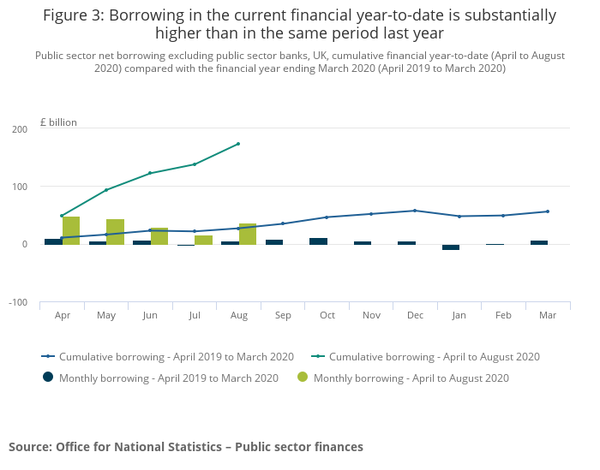
The total borrowing to 31 August 2020 was £173.7bn.
But at a special meeting on 19 March, the Bank of England Money Policy Committee voted unanimously to increase the Bank of England’s holdings of UK government bonds and sterling non-financial investment-grade corporate bonds by £200 billion. To do so it had to
print ‘new’ money.
By the end of August £176 billion had been spent by the Bank of England on gilts with the new money it had printed - which was more than had been borrowed by 31 August. (Since then more gilts have been acquired. Details have not been published as yet, however,
the margins are heavily in favour of gilt purchases still exceeding borrowing).
In other words, the Government has not borrowed any new funds this year. Funding has instead been paid for with new Bank of England created money. And if you doubt that this is new money, the Bank of England says it is: “The aim of QE is simple: by creating this ‘new’ money, we aim to boost spending and investment in the economy.”
The argument that the taxpayer and bond markets are paying for the coronavirus crisis is wrong. We are not borrowing. We are printing new money to pay for the coronavirus crisis.
And if it is said that money is not available to pay for continuing support for those who are suffering as a result of this crisis that is untrue: instead a political decision has been taken to not create the money required to support them, or to borrow to do so. And deciding
not to support people is not the same as being unable to support people.
So next time a journalist asks a Government Minister “How are you going to pay for it?” wait and see if the reply is “We’ll just print some more money.” Spoiler alert – it won’t be.
What did you expect - the truth?
Noel Guilford